



 Dejan Kosutic
This article is based on an episode from the Cyber & AI Perspectives podcast. Prefer listening instead? Listen to the audio version below.
Most companies that use AI have one thing in common: They struggle with how much they trust their AI systems. Consequently, they try to figure out how to decrease AI risks in order to increase the trustworthiness of their AI systems, and these activities are a major part of AI governance.
And there are a couple of useful AI governance frameworks that you can use for that purpose — for example, ISO 42001 or NIST AI Risk Management Framework.
The AI Risk Portfolio Matrix helps organizations identify which AI uses need attention first, based on potential impact, reach, and autonomy. It provides a starting point for deeper risk assessment and governance decisions.
Why AI risks are difficult to prioritize
Companies typically use numerous AI systems for very different purposes. Some of these have little risk involved, like AI-powered meeting applications that draft summaries of meetings where only non-sensitive information is shared. Others are very risky, for example, AI agents might be controlling industrial equipment across multiple production facilities.
But there are also AI systems where the level of risk might not be quite so obvious — e.g., you might have an AI assistant for drafting emails, or AI-powered applications that support recruitment decisions for senior management positions in a company.
So, companies face two problems here: First, they are using AI in too many different ways, and it is hard to have an easy overview of all of them, and second, it is sometimes hard to determine which AI systems are more important, and which are less so.
No matter which framework companies use for AI governance, they often get stuck at the very beginning — they struggle to see the big picture, and they do not know how to choose what to focus on.
The AI Risk Portfolio Matrix
With these problems in mind, I developed the AI Risk Portfolio Matrix, which helps companies list their AI systems and prioritize them, all within the same matrix.
This is a two-by-two matrix that combines three key factors: Criticality, Reach, and Autonomy.
On one axis you have Criticality, meaning how serious the consequences of an AI-related incident could be for people, processes, and data. On another axis you have Reach, meaning how much of the organization or external world is exposed to that consequence. And then you display your AI system within this matrix as a bubble, where the size of the bubble indicates Autonomy, meaning how much the AI system is allowed to act on its own.
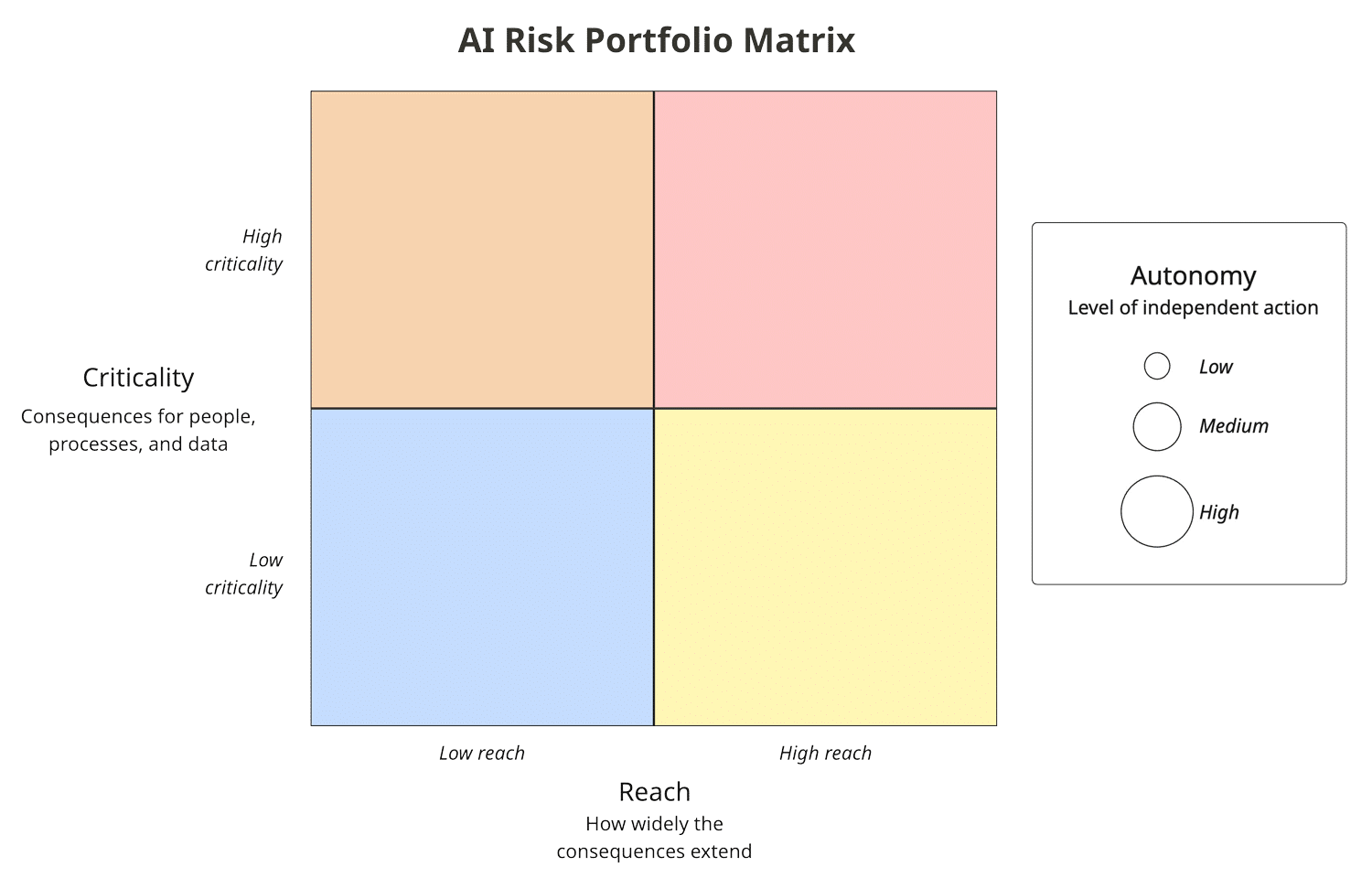
The purpose of the matrix is not to calculate the actual level of risk of an AI system, but to help you identify which AI systems deserve closer examination first.
Criticality, Reach, and Autonomy
Let me explain these three factors in more detail.
Criticality. To consider the level of criticality, you should take into account consequences for people, data, and processes that could be affected by an AI incident. Essentially, you ask the following question:
“If the AI gets this wrong, how serious could the consequence be?”
Therefore, consider what the consequences would be for things like health & safety and personal, financial, or confidential business data, plus consequences like a production stoppage, approval of incorrect payments, a breach of contractual or legal obligations, and so on.
Reach. For assessing the level of reach, you should consider which people, decisions, systems, stakeholders, and others would be affected. In other words, ask:
“How widely could those consequences extend?”
So here you have to think about, for example, how many employees are using a particular AI system, how many people could be affected by its outputs, how many decisions rely on it, how many processes or departments are using it, whether its outputs affect external parties, and so on.
Autonomy. For autonomy, you have to analyze how far the AI system is allowed to make decisions or carry out actions without human approval. In other words, ask yourself:
“How much do you allow the AI system to act on its own?”
For this aspect, you have to assess if the AI system only provides advice, or if it makes decisions, or if it also carries out certain actions.
So, to summarize, Criticality is about seriousness, Reach is about the blast radius, and Autonomy is about control.
The four AI risk quadrants
I divided this matrix into four quadrants so that you can prioritize your systems more easily:
- Limited for low Criticality and low Reach,
- Serious for high Criticality and low Reach,
- Exposed for low Criticality and high Reach, and
- Amplified for high Criticality and high Reach.
Let’s see how we could position the examples from before into this matrix.
An AI system for drafting summaries of meetings with non-sensitive information would typically have low Criticality, because the consequences of an incorrect summary would normally be limited. Its Reach could be low or medium, depending on how much the company is using this system. For Autonomy, the bubble could be medium-sized because the system operates rather independently, but participants can always come back and correct the summary if needed. So, this kind of AI system would typically fall into the Limited quadrant.
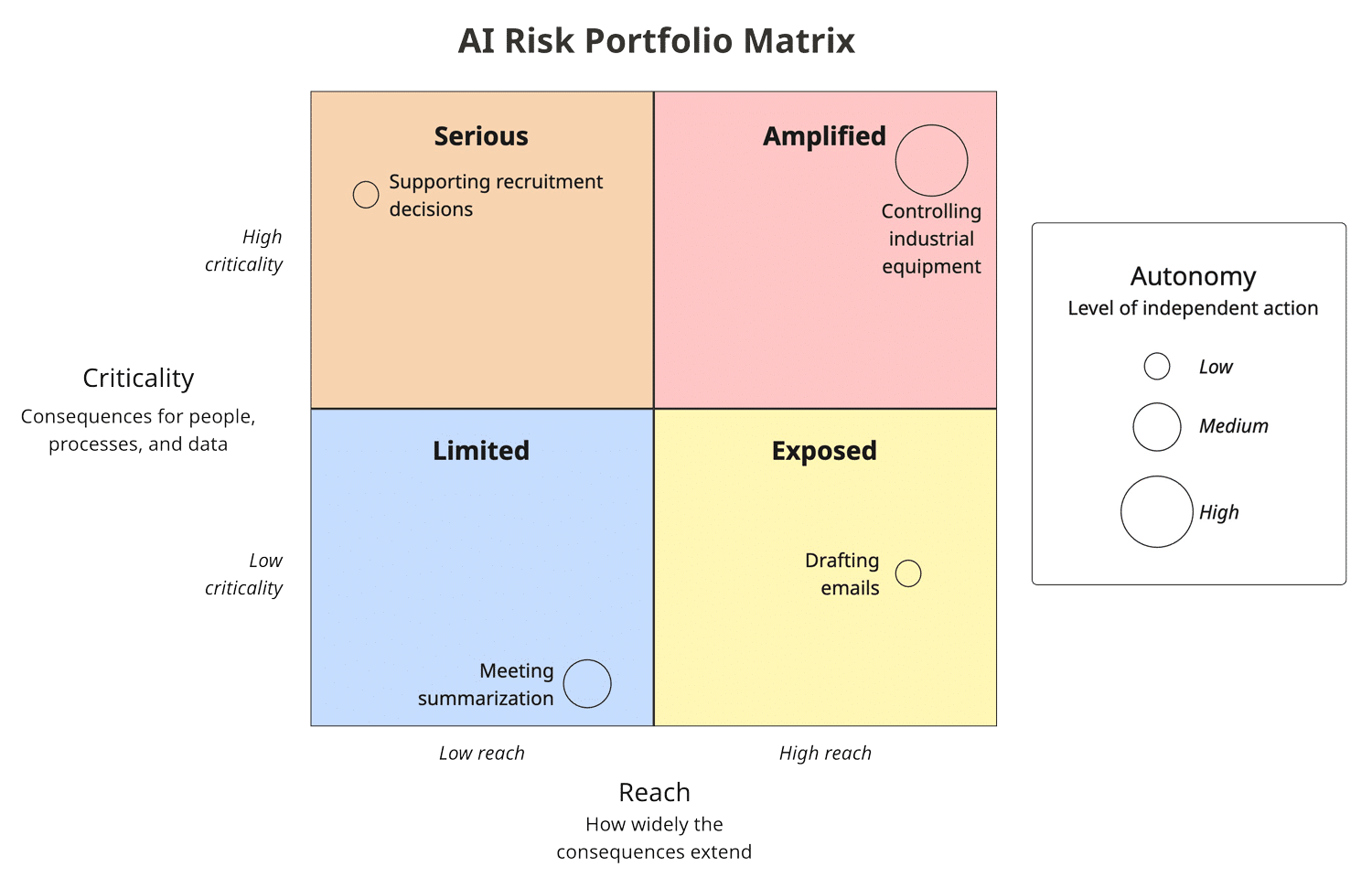
An example of the Serious quadrant could be an AI system that supports an important decision involving a limited number of people. For example, an AI system used to support recruitment decisions for senior management positions could have high Criticality, while its Reach could remain relatively low. For Autonomy, the bubble would be small because the system would (hopefully) not be able to make a hire by itself.
An example of the Exposed quadrant could be an AI assistant for drafting emails used by thousands of employees. The consequences of an individual mistake might not be very serious, but the system is used across a large part of the organization. Here, the Autonomy bubble would also be small if the AI system only drafts emails but does not send them automatically.
And finally, AI agents controlling industrial equipment across multiple production facilities could fall into the Amplified quadrant. This would have high Criticality because of the potentially serious consequences for production, equipment, or people; high Reach because it affects multiple production facilities; and a big bubble for Autonomy if the system makes its own decisions without human involvement.
What the matrix does — and does not do
This matrix is not an all-powerful solution for your AI risk assessment.
Its main purpose is to answer one question: “Which AI systems deserve closer attention first?” but it does not answer: “What is the actual level of risk of this AI system?”
Therefore, it is not a replacement for detailed AI risk assessment — it does not analyze in detail model reliability, hallucination, data quality, bias, security, and so on; further, the AI Risk Portfolio Matrix is focused more on impact rather than likelihood.
Also, it is not a replacement for various assessments that need to be performed according to the EU AI Act — risk assessment for high-risk AI systems, fundamental rights impact assessment, and systemic-risk assessment for providers of general-purpose AI models with systemic risk. Those assessments require many more inputs than what I’m proposing for this AI Risk Portfolio Matrix.
How organizations can use the results
So, what can you use this matrix for?
I would say its biggest value is to use it as one of the first steps in your AI governance, when you’re trying to figure out where to start and which AI systems you want to focus on.
The matrix is easy to understand for everyone — from senior executives to the IT team. It shows the entire AI portfolio and highlights which systems require greater attention, making it easier to move AI governance forward.
In practice, this means that you can do the following with this AI Risk Portfolio Matrix:
- Prioritize next steps — Each next step, like detailed risk assessment and introducing controls, will likely take lots of time and effort; therefore, you want to make sure you’re focusing on the right thing.
- Allocate resources — If you’re not sure which AI systems deserve a bigger budget, this matrix gives you a clear perspective from the risk point of view.
- Review new AI proposals — When considering new AI systems, it becomes easier to take the AI risk perspective as part of the decision-making process.
- Communicate AI risks to management — The matrix gives senior executives a simple overview of the whole AI portfolio without requiring them to understand the technical details of every AI system.
A technology-agnostic management tool
Another benefit is that these three factors — Criticality, Reach, and Autonomy — do not depend on a particular technology. AI models or AI vendors can change, but these three factors stay equally relevant.
Therefore, the AI Risk Portfolio Matrix can provide a business and strategic perspective of AI risks, not purely technological, and remain a useful management tool even when AI technologies are changing quickly.