



 Dejan Kosutic
This article is based on an episode from the Cyber & AI Perspectives podcast. Prefer listening instead? Listen to the audio version below.
Recently, the CEO of a very successful consulting company asked me two questions: “Will AI take over consulting? Will there be any work left for consultants?”.
AI will not eliminate the need for consultants, but it will significantly reduce the value of traditional consulting services such as routine advice and documentation. The future of consulting lies in helping clients innovate, manage organizational change, and achieve business transformation.
I started my answer with my own experience of using AI.
How AI is taking over traditional consulting work
Advisera, the company where I’m the CEO, is a training provider and a personnel certification body. We’re currently going through the process of ISO 17024 accreditation — basically, this means verifying that we are conducting the examination and certification of professionals according to the top international standard.
As part of this process, we had to perform an exam validity assessment — this is a very detailed and complicated process, and even though we had validated our exams before, we had never done it on such a scale and in such depth. Until a year or two ago, we would have needed to hire a consultant to do this. There were simply too many details that would have taken us months to learn on our own.
However, this time I decided to use ChatGPT to guide me through the whole process. And here’s what happened: I gave it a prompt explaining what I needed to achieve, and it took me step by step through the entire process.
Altogether, our conversation lasted about 10 hours. We exchanged a couple of hundred messages in a single thread: It asked me questions related to each step, and I provided the answers; it suggested solutions, which I often accepted, but sometimes challenged; and whenever an important decision had to be made, it asked for my approval.
And yes, a couple of times we even ended up in an argument because I didn’t agree with its suggestions. In some cases, I was right, but more often than not, it managed to convince me.
Ultimately, it took into account all the relevant details about our company and the decisions I had made, and then it produced a detailed report. And what fascinated me most was how well it kept track of all the details throughout this very long conversation.
Now, this isn’t really about ChatGPT. I could probably have done something similar with Claude, Gemini, or another advanced AI chatbot. The important point is what AI enabled me to achieve.
So, here’s my conclusion: The traditional consulting business model, where consultants mainly guide clients through a process, create documentation, or answer questions, will soon come under enormous pressure. AI is already capable of performing much of this work, and it will only get better at it.
Innovation and change as the key value drivers
But do I think consulting is dying as a profession? Definitely not — companies will still need outside help and fresh perspectives, but I believe they’ll need them in a very different way. The way I see it, consultants have two big opportunities — two areas where human consultants will continue to have a significant advantage over AI for years to come.
The first opportunity is innovation. By this I mean helping clients develop new strategies, different business models, unique approaches to business development, new products, and so on. Currently, AI is very good at suggesting incremental improvements, especially when the problem is clearly defined. But when it comes to original, outside-the-box thinking that takes into account the unique circumstances of a particular company or market, I believe humans still have an advantage.
The second opportunity is change management. This is when consultants help their clients actually implement changes, whether in their processes, strategies, organizational structures, or ways of working. AI definitely cannot do all of this alone. As you probably know, change management is very hard. There are often misunderstandings, poor communication, resistance, and fear. In other words, you’re dealing with unpredictable human reactions that require trust, persuasion, and personal interaction. I do not think that AI will be able to do this any time soon.
Consulting Evolution Matrix
And this brings me to something I’ve developed — I call it the Consulting Evolution Matrix, which helps explain the relationship between innovation and change management in consulting.
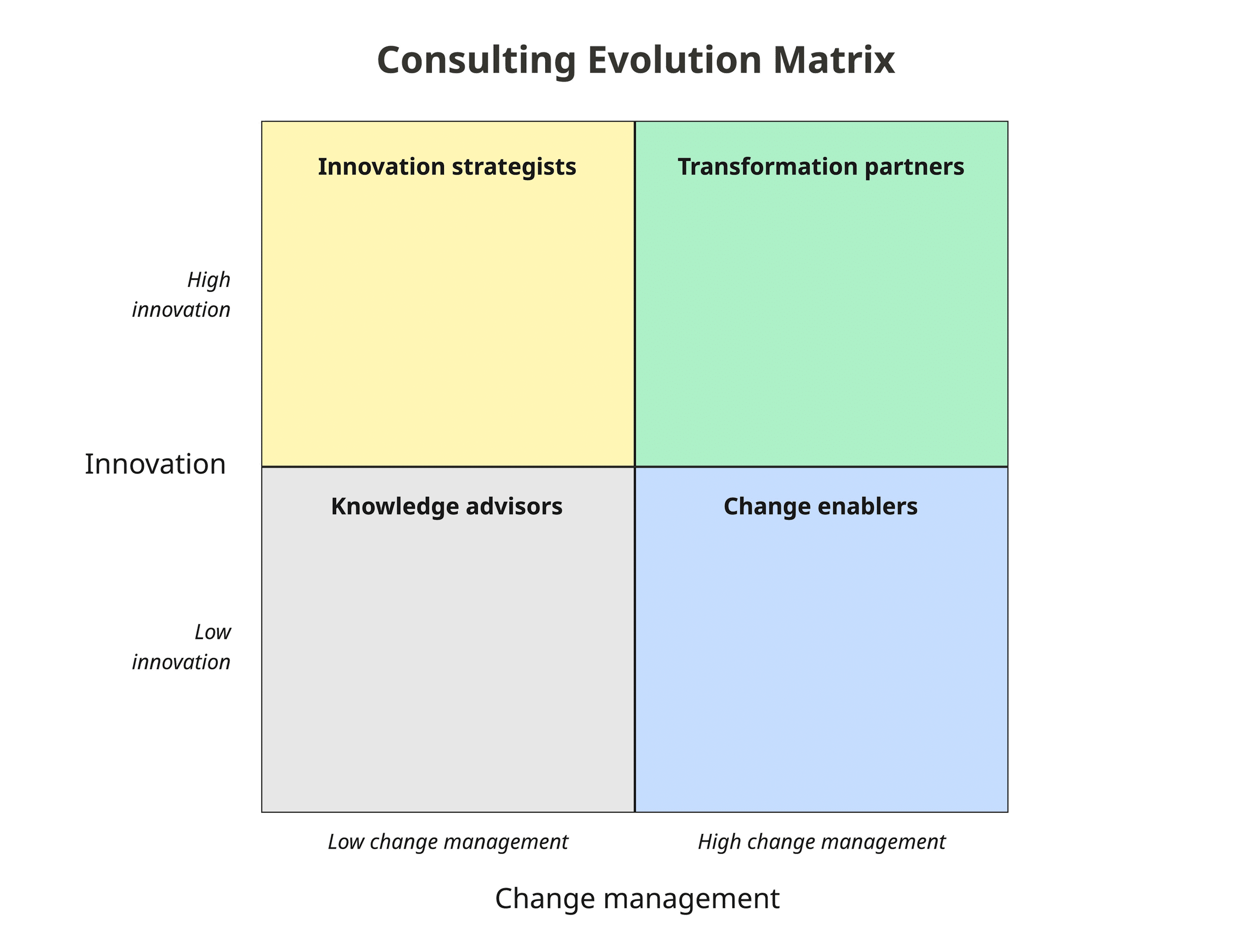
On one axis, we have innovation — this measures how much consultants help their clients develop new strategies, products, business models, or ways of creating value. On the other axis, we have change management — this measures how much consultants help their clients actually implement changes and get people to adopt new ways of working.
Together, these two dimensions give us four quadrants, describing four different consulting approaches.
Knowledge advisors. This is an approach I often see in consulting related to ISO standards. For example, a client wants to get their company certified against ISO 9001, and they hire a consultant to do the compliance work. In some cases, this work mainly comes down to defining processes and writing documents, although it may also include analysis or training.
In these types of engagements, consultants usually do not introduce anything innovative, nor do they help the company implement the changes in their processes.
Innovation strategists. An example would be a consultant who helps a client develop a strategy for a new AI-powered product because the client’s existing product became obsolete due to generic AI chatbots. As part of this strategy, the consultant researches the market, identifies opportunities, helps develop the product concept, and determines the best go-to-market approach.
This is a great niche for someone who’s creative and enjoys developing new ideas and strategies, but who doesn’t necessarily want to get involved in implementing those innovations within the client’s organization.
Change enablers. An example would be a consultant who helps a client with ISO 27001 implementation, but this consultant doesn’t stop at guiding the client through the process or writing documentation. She also helps configure IT systems, explains to employees what needs to change, guides the company through changes in its processes, and helps build a stronger security culture. This example is actually quite close to what many virtual CISOs, or outsourced information security managers, are doing currently.
This is also an excellent niche, and you do not need to be innovative to succeed here, but you do need to be very good at working with people and helping them adopt changes.
Finally, Transformation partners. This is what I consider the sweet spot — a combination of innovation and change management. For example, think about consultants who help companies introduce AI agents into their operations. This requires innovative thinking about how AI can be used to redesign business processes. But it also requires a great deal of change management, because these agents can fundamentally change how people work and how companies operate.
Ultimately, these consultants help companies with business transformation.
What should consultants do?
I believe business transformation is where we’ll see some of the biggest growth opportunities for consultants. Why? Because AI is probably the most important technology of our time, and we’re still at the very beginning of what it will become. At the same time, AI will enable companies to fundamentally rethink how they operate — from their business models and products to their internal processes and organizational structures. And helping companies navigate this transformation will create enormous opportunities for consultants.
Now, don’t get me wrong — I don’t think all consultants should go for the Transformation partners quadrant. That wouldn’t be realistic, and it’s simply not necessary. There are plenty of opportunities for Innovation strategists and Change enablers, and I believe they’ll be able to maintain a competitive advantage over AI for a long time.
But if you’re currently operating mainly as a Knowledge advisor, I think you should seriously consider moving toward one of the other quadrants, because the amount of money in this quadrant is going to decrease continuously.
Does this mean you need to change your business model immediately? Probably not; but probably yes in the next couple of years.
Of course, this won’t be easy. Consultants themselves will need to rethink their services, develop new skills, and change how their companies operate. And there’s a certain irony here: Consultants who advise other businesses on how to change will now have to go through a major transformation themselves.