 Dejan Kosutic
Many consultants start with the wrong priorities, and after six months in their career as an independent consultant, they’re still waiting for traction — burning through savings and wondering what’s wrong.
Most often, the problem is four-fold: Consultants do not know (1) how to match their specific experience with market needs, (2) where to get the know-how, (3) how to reach out to potential clients, and (4) how to control costs.
This article explains which steps to follow to overcome these challenges.
Launching a consultancy requires a defined niche, a lean business setup, relevant certifications, and structured service delivery. Success is not going to come from one of these areas alone — instead, success depends on making sure you cover the key angles from the start.
Which steps are needed?
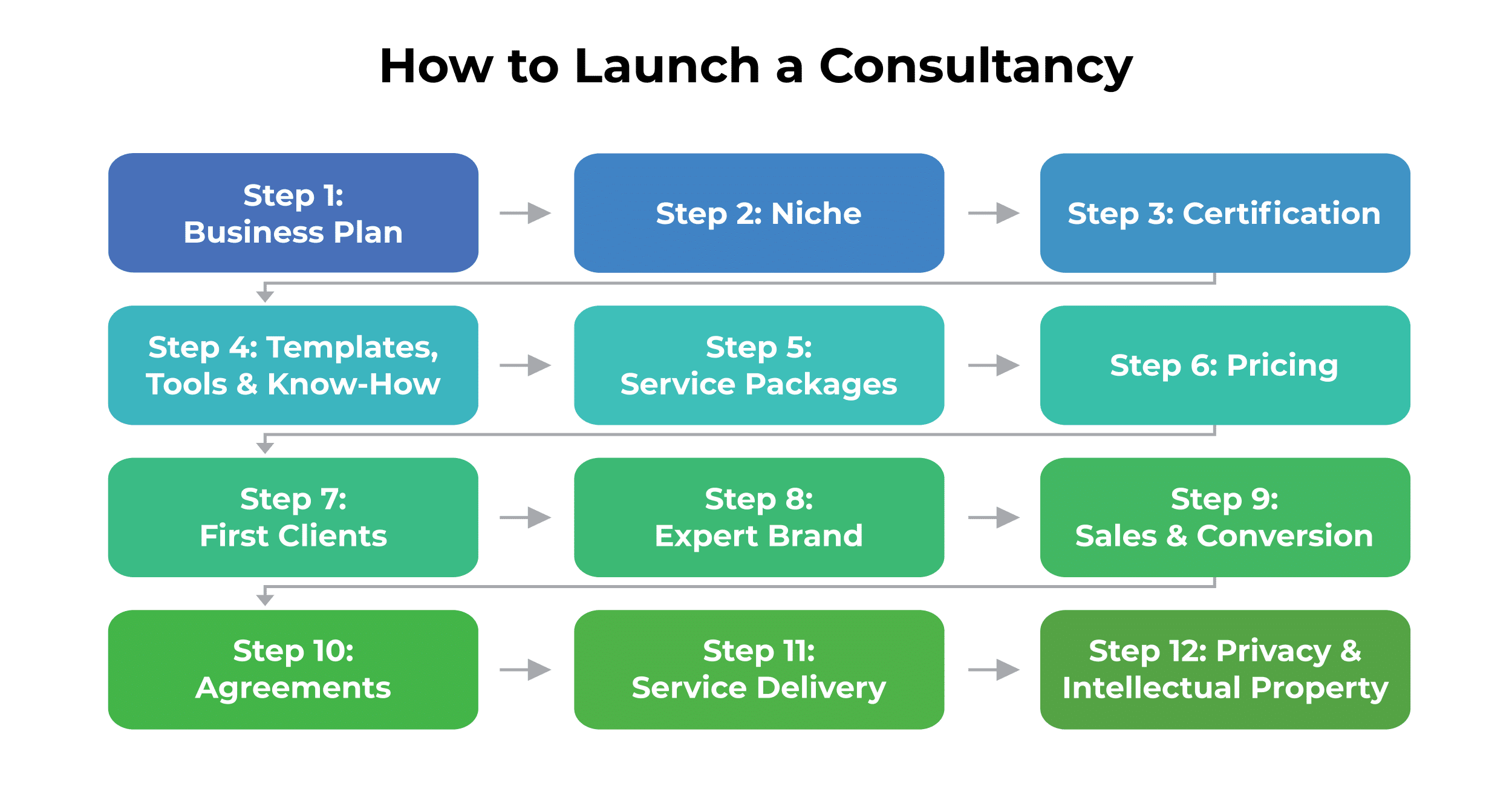
From my experience, following the 12 steps listed below will give you the best chance of succeeding as an independent consultant.
Don’t try to skip any of these steps — as you will notice, most of them are interdependent, and omitting one step will disable you from doing the next, ultimately leading to failure.
Step 1: Define your business plan and legal setup
A consultancy must begin with a clear understanding of its cash flow. Estimate your monthly costs like software, internet, equipment, and registration fees and compare them with the amount that you have available, before expecting profitability. This exercise defines your break-even point and gives you a realistic timeline for sustainability.
Legal setup depends on your jurisdiction. In some countries, you can operate as a sole proprietor, while in others, you must register a company. Choose the lowest-cost option available, because you can always upgrade later once revenue stabilizes. For most consultancy services, no license is required, but certifications will be essential for credibility and sales.
A detailed breakdown of this step is provided in the second half of this article.
Step 2: Choose a niche
Generalist consultants rarely win contracts, because clients prefer specialists who can solve specific problems. Your niche should reflect both your expertise and market demand. For example, a consultant who focuses on ISO 27001 implementation for small SaaS B2B companies will win a contract more easily than a consultant who just provides ISO 27001 consulting services.
Your niche defines your positioning, messaging, and pricing, and it also determines which certifications and tools you will need in order to deliver services effectively.
Step 3: Acquire certifications
Certifications are not just credentials — they are sales tools. Clients want proof that you are qualified, and certifications provide that assurance. Depending on your niche, you may need ISO 27001 Lead Implementer or Lead Auditor certification, GDPR Data Protection Officer certification, or something similar to this. These programs also provide a delivery structure and reduce risk by standardizing your approach.
You don’t need every certification available. Choose one or two that directly support your niche, and use them to establish credibility. This is enough to begin selling services and building trust. Later, as your consultancy grows, you can expand your portfolio with additional certifications.
See here a list of Lead Implementer courses.
Step 4: Acquire templates, tools, and know-how
Consulting requires delivery assets that allow you to execute services consistently. Without them, every engagement would start from scratch, wasting effort and reducing efficiency.
You can typically find a set of templates for policies, procedures, and other documents for any standard or other framework that you want to focus on — they enable you to write down any organizational activity and internal rule.
Tools are a step further — they enable you to automate various activities. For example, governance, risk, and compliance (GRC) software is very popular for implementing cybersecurity standards and regulations because such software automates risk assessment and treatment, evidence collection, etc. Also, training platforms are getting more and more popular because they automate training and awareness programs for a larger number of employees.
Getting the know-how is another step forward — it enables you to gain insight into what to do in a particular situation with a client. Such knowledge is typically not publicly available, and the best way to get it is to find a mentor (or one-on-one consultation service) who is willing to coach you.
You might find these Advisera products useful: consultant toolkits, Conformio for Consultants, and Company Training Academy for Consultants.
Step 5: Package your services
Clients do not buy “consulting”; they buy outcomes. Your services must be packaged into clear consulting tasks such as gap analyses, implementation of a standard, or monthly advisory retainers. Each package should define scope, timeline, and price so that clients know exactly what they are purchasing.
Structured packages simplify proposals and help you get new customers. They also allow you to standardize delivery across multiple clients. Vague offers lead to slow sales and unclear expectations, while packages create clarity and confidence for both sides.
Step 6: Define pricing
Avoid pricing your services lower than the competition, because then you’re positioning your consultancy as a low-quality provider in the eyes of potential customers. Instead, aim at market-based pricing where you can charge a slightly premium price based on your specific market niche.
There are different pricing models: hourly rates, project-based, retainer, or outcome-based pricing — hourly rates work for advisory calls, fixed fees work for defined deliverables, and retainers work for ongoing support.
For your initial rate, you should research what other consultants offer by checking their websites; asking on Reddit; checking job sites like Upwork, Toptal, and Clarity.fm; and using other techniques that will tell you what the common prices are for your specific region and for your specific niche.
Step 7: Find your first clients
You should define what your ideal client profile (ICP) looks like based on your niche, and then reach out to your existing network: former colleagues, LinkedIn contacts, and industry peers. Focus on conversations rather than pitches — ask about their challenges, share insights, and offer help. Trust is the foundation of early engagements.
Beyond your existing network, you can start reaching out via LinkedIn directly to prospects, but also apply for open projects on specialized job sites and consultant directories.
See also: Advisera’s Consultant Directory.
Step 8: Build your brand as an expert
Since your network is limited, you will also need to generate leads without reaching out to them directly. You can do this by building visibility — publishing articles, speaking at events, sharing useful content via social media, etc. Consistency matters more than volume; a steady presence builds credibility over time.
Start with a simple website that explains what you specialize in, your services, and contact information. Add articles that demonstrate expertise and share them on LinkedIn. Branding is not about design — it is about being known for solving a specific problem. If people associate your name with a solution, you will have succeeded.
Step 9: Present your services and convert clients
When meeting potential clients, clarity is essential. Use structured proposals that define scope, timeline, deliverables, and price. In the meeting, focus on presenting three things: problem, solution, and results.
Conversion depends on trust. A vague proposal creates hesitation, while a detailed, outcome-focused proposal creates confidence. Follow up promptly, answer questions directly, and maintain professionalism. Consistency in presentation leads to contracts.
Step 10: Sign agreements
Always use written agreements. They protect both you and the client by setting expectations clearly. Agreements should include responsibilities, payment terms, confidentiality, and intellectual property clauses. This structure reduces disputes and demonstrates professionalism.
Make sure you specify what your consulting services include, but also what is excluded — this way, you drastically increase the chances of having a satisfied client at the end of the project.
Clients expect consultants to operate with clear boundaries. Delivering agreements from the start signals that you are serious about your work and that you respect the client’s interests. It also provides a framework for resolving issues if they arise.
Step 11: Deliver services
Delivery is where reputation is built. Based on your niche and your consulting package, you will have very different ways to deliver services — for example, you might focus on implementing particular ISO standards, or performing training projects, or doing only internal audits, or perhaps only maintaining their management systems.
No matter what kind of service you deliver, meeting expectations, communicating regularly, and documenting your work are essential. Protecting client data is non-negotiable — security and professionalism must be part of every engagement.
Each project becomes a reference point. If you deliver well, clients will refer others, but if you miss deadlines or ignore feedback, they will not. Reputation compounds over time, and every delivery either strengthens or weakens it.
Step 12: Manage privacy and intellectual property
Consulting often involves access to sensitive information, and you must protect privacy and intellectual property. Use secure tools, include standard clauses in agreements, and handle client data responsibly. This is not optional — it is part of professional delivery.
Mishandling privacy or IP damages trust and creates legal risk. Professional consultants treat confidentiality as integral to their work, not as an afterthought. Protecting these elements ensures long-term credibility and client loyalty.
Business plan and legal setup
Let’s now go through the first step that you have to perform.
Defining a business plan
Most consultants overcomplicate the first step and try to write a very lengthy business plan — at the very start, you do not need that; what you need is more of a cash flow model.
Start by calculating your monthly operating costs: software, internet, equipment; then, estimate how much revenue you might generate in the first few months. The revenue part is uncertain, so focus on what you can control: costs. Keep them low — use your existing laptop; work from home; don’t rent office space or hire designers.
Next, define how much money you’re able to invest in your business before expecting a profit. This gives you a financial boundary and a timeline. If you know you can sustain six months without income, you’ll make different decisions than if you only have two.
By doing this kind of cash flow estimate, you will have a much clearer idea of what your options are and how far you can go.
Legal setup for a consultancy
Legal setup depends on your jurisdiction. Some countries let you operate as a sole proprietor, while others require a formal company registration before you can begin.
In any case, you should choose the lowest-cost option available — you can always upgrade your legal status later, once business takes off. The goal is clear: Minimize upfront costs and complexity.
It might seem strange, but for most consultancy services, no license is required to operate — you don’t need some special permission to start. However, certifications for you as a professional will be essential for credibility and sales — this is explained in Step 3.
Success factors
It is hard to say which of the steps listed above are the most important to succeed — I would say that success lies in executing all of those steps altogether.
But going back to my initial statement of the four things where most new consultants fail — make sure you do the following: Match your specific experience with market needs, get appropriate know-how, make your outreach aggressive, and, finally, keep your costs low.
To learn how to launch your consultancy, sign up for this free online Beginner’s Course for ISO, Cybersecurity, and AI Consultants that will explain each of the 12 steps in more detail.