 Carlos Pereira da Cruz
Many organizations certified to ISO 14001 ask the same question whenever a revision approaches: Do we need to redesign our environmental management system (EMS)?
The short answer with ISO/FDIS 14001:2026 is no — but that doesn’t mean that nothing changes. The real challenge is subtler. Organizations that treat ISO 14001 as a static compliance framework may struggle, while those that already use the EMS as a management tool will find the transition almost natural. Understanding the intent behind the changes is therefore more important than memorizing clause-by-clause edits.
- Stronger emphasis on environmental context and external conditions (clause 4.1)
- Life-cycle thinking reinforced in EMS scope and planning (clauses 4.3 & 6.1)
- Clearer integration of environmental aspects, compliance obligations, and risks (clause 6.1)
- Shift from formal compliance toward demonstrable environmental performance
What ISO/FDIS 14001 is — and is not
ISO/FDIS 14001 does not introduce a new environmental management model. The Plan-Do-Check-Act logic remains intact, as do the core requirements familiar from ISO 14001:2015.
What changes is the clarity of expectations. The final draft standard tightens wording, reduces ambiguity, and reinforces how different requirements are meant to work together in practice. The emphasis moves away from isolated procedures and toward coherent environmental decision making.
In practical terms, this means fewer excuses for superficial implementation.
Overview of changes in ISO/FDIS 14001:2026
Clause 4: Context of the organization
4.1 Understanding the organization and its context. Clause 4.1 places greater emphasis on determining environmental conditions that can affect, or be affected by, the organization. Examples explicitly highlighted include climate change, natural resource availability, ecosystem health, and biodiversity.
This is not about writing longer context analyses. It is about recognizing that environmental performance is shaped by external realities, not just internal processes.
The diagram below illustrates how this requirement should be understood in practice. It shows how external environmental conditions influence organizational activities (such as production, energy use, supply chains, and waste management), which in turn generate environmental aspects and impacts (such as emissions, resource consumption, and pollution).
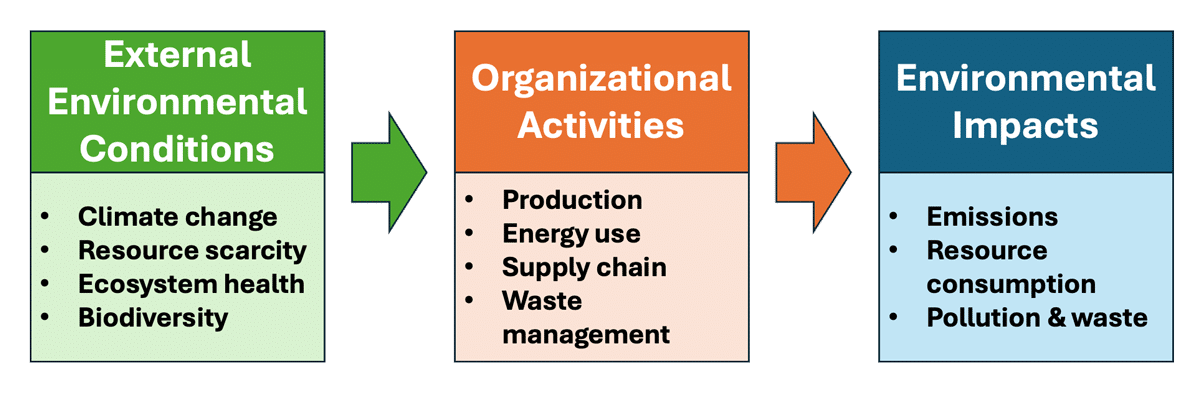
In other words, clause 4.1 requires organizations to start their environmental thinking upstream — from external environmental conditions — and to consider how these conditions shape risks, opportunities, and environmental performance, rather than treating context as a purely descriptive or standalone exercise.
4.2 Understanding the needs and expectations of interested parties. The requirement to determine the relevant needs and expectations of interested parties remains unchanged, while an explanatory note clarifies which types of needs and expectations should be considered.
Organizations are expected to show discernment — not to list everyone, but to justify relevance.
4.3 Determining the scope of the environmental management system. The life-cycle perspective is now explicitly required when determining the scope of the EMS. While life-cycle thinking already existed in ISO 14001:2015, the draft removes any ambiguity about its relevance at the scoping stage.
This reinforces the idea that environmental responsibility does not stop at the factory gate.
To learn more, read this article: How to use the inputs from the context of the organization (clauses 4.1 and 4.2) to build your management system.
Life-cycle thinking example
Based on the changes in clause 4.3, a manufacturing company may already control emissions and waste on its own site, but ISO/FDIS 14001:2026 makes it harder to ignore upstream and downstream impacts when defining scope and planning actions. A practical response could be reviewing raw material sourcing because of biodiversity risks, or redesigning packaging to reduce environmental impacts during transport and disposal. The key difference is that life-cycle thinking is no longer an abstract concept; it must influence what the organization chooses to manage.
Clause 5: Leadership
Clause 5 introduces only minor editorial changes. However, this should not be misread as reduced importance.
Leadership remains central: Accountability, integration into business processes, and alignment with strategic direction are unchanged expectations. What the final draft standard does is maintain pressure on leadership without expanding formal requirements.
In practice, auditors are likely to focus less on policy statements and more on how leaders influence environmental decisions.
Clause 6: Planning
6.1 Actions to address risks and opportunities. Clause 6.1 has always been the core planning clause of ISO 14001, bringing together environmental aspects, compliance obligations, and risk-based thinking. In ISO/FDIS 14001:2026, this clause is not redesigned, but it is clarified, tightened, and structurally refined to reduce ambiguity and improve consistency in application.
In the following table, we compare the clause 6.1 structure between ISO 14001:2015 and ISO/FDIS 14001:2026.
| ISO 14001:2015 | ISO/FDIS 14001:2026 |
| – 6.1.1 General – 6.1.2 Environmental aspects – 6.1.3 Compliance obligations – 6.1.4 Planning action |
– 6.1.1 General – 6.1.2 Environmental aspects – 6.1.3 Compliance obligations – 6.1.4 Risks and opportunities – 6.1.5 Planning action |
In ISO 14001:2015, clause 6.1 was structured logically, but in practice it often led organizations to treat environmental aspects, compliance obligations, and risks and opportunities as parallel or even separate exercises, rather than as elements of a single planning logic.
ISO/FDIS 14001:2026 clarifies how the subclauses work together by strengthening cross-references and improving internal consistency. The change is therefore not about renumbering, but making the planning logic clearer and more coherent.
6.1.1 General. Now this subclause is really an introduction to the rest of the whole clause 6.1.
6.1.2 Environmental aspects. An explanatory note was introduced to clarify how the life-cycle perspective should be applied, and a requirement was added to determine potential emergency situations independently of the identification of environmental aspects. (In the previous version, this was part of risks and opportunities.)
See also: Understanding the relationship between environmental aspects and operational procedures.
6.3 Planning of changes. While the concept of managing change already existed implicitly in ISO 14001:2015, the revised standard now makes planning of changes an explicit requirement.
The intent is to ensure that changes affecting the EMS (for example: new or changes to existing products, services, operations, equipment, or facilities) are planned, controlled, and evaluated, rather than implemented reactively.
Here’s some more info: What makes an environmental aspect significant in ISO 14001?
Example of a single planning logic
Many organizations previously assessed environmental risks separately from aspect evaluation and compliance obligations. Under the final draft standard, these elements are expected to converge. Based on the changes in clause 6.1, for instance, a company operating in an area increasingly exposed to extreme weather should be able to show how climate-related risks affected the prioritization of environmental aspects, emergency preparedness, and environmental objectives — even if no legal requirement explicitly demands it yet.
Clause 7: Support
Only minor editorial changes.
Clause 8: Operation
8.1 Operational planning and control. The new standard expands the requirement from controlling outsourced processes to controlling or influencing externally provided processes, products, or services that are relevant to the intended outcomes of the EMS, reinforcing a risk- and outcome-based approach to external providers.
Clause 9: Performance evaluation
9.2.2 Internal audit programme. Internal audits must now include defined objectives, in addition to scope and criteria.
To learn more, read this article: Risk-Based Auditing: A Smarter Way to Ensure Management System Effectiveness.
9.3 Management review. The content remains unchanged, but the subclauses “General,” “Management review inputs,” and “Management review outputs” have been added.
See also: The importance of management review in the ISO 14001:2015 process.
Clause 10: Improvement
10.1 Continual improvement (renumbered from 10.3). Clauses 10.1 and 10.3 of the 2015 version have been merged into a single clause, now renumbered as clause 10.1 “Continual improvement.”
Annex A: Guidance on the use of this document
Two wording updates were introduced. References to “maintaining documented information” have been replaced by “making documented information available,” and references to “retaining documented information as evidence” have been reformulated to require that documented information be available to demonstrate conformity.
This annex has been significantly expanded and now includes many additional explanatory notes, some of which provide detailed content and illustrative examples. The final section also includes a table to help locate definitions.
Summary of changes in FDIS ISO 14001:2026
| Clause number | Clause name | Degree of change |
| 4.1 | Understanding the organization and its context | Moderate |
| 4.2 | Understanding the needs and expectations of interested parties | Moderate |
| 4.3 | Determining the scope of the environmental management system | Moderate |
| 4.4 | Environmental management system | No change |
| 5.1 | Leadership and commitment | No change |
| 5.2 | Environmental policy | No change |
| 5.3 | Roles, responsibilities and authorities | No change |
| 6.1.1 | General | Moderate |
| 6.1.2 | Environmental aspects | Moderate |
| 6.1.3 | Compliance obligations | No change |
| 6.1.4 (previously 6.1.1) | Risks and opportunities | No change |
| 6.1.5 | Planning action | No change |
| 6.2.1 | Environmental objectives | No change |
| 6.2.2 | Planning actions to achieve environmental objectives | No change |
| 6.3 | Planning of changes | Major |
| 7.1 | Resources | No change |
| 7.2 | Competence | No change |
| 7.3 | Awareness | No change |
| 7.4 | Communication | No change |
| 7.5 | Documented information | No change |
| 8.1 | Operational planning and control | Moderate |
| 8.2 | Emergency preparedness and response | No change |
| 9.1.1 | General | Small (editorial) |
| 9.1.2 | Evaluation of compliance | No change |
| 9.2.1 | General | No change |
| 9.2.2 | Internal audit programme | Moderate |
| 9.3 | Management review | Small |
| 10.1 (10.3) | Continual improvement | Major |
| 10.2 | Nonconformity and corrective action | No change |
Timeline and transition considerations
ISO 14001:2026 is expected to be officially published in Q1 or early Q2 of 2026, most likely in March or April. Once the standard is published, certification bodies may begin auditing against ISO 14001:2026 once accreditation rules have been updated, which typically takes a few months, and organizations are not expected to transition immediately.
At the FDIS stage, technical content is frozen, and only editorial corrections are allowed. Because the FDIS content is stable, organizations can already start aligning their EMS, and consultants and auditors can prepare interpretations and guidance.
What does this mean for certified organizations?
For most organizations, the transition will not require restructuring the EMS. Instead, it will require:
- reviewing how context is defined and used,
- checking whether life-cycle thinking genuinely influences scope and planning, and
- ensuring that risks, aspects, and obligations are managed as one system.
The gap is rarely technical. It is managerial. ISO/FDIS 14001 does not raise the bar by adding new requirements — it raises it by removing ambiguity.
The final draft standard reinforces a simple message: Environmental management systems exist to support better decisions and real environmental performance, not just certification.
Organizations that understand this will transition smoothly. Those that do not may discover that the real change is not in the standard, but in how the EMS is expected to be used.
Order the ISO 14001 Premium Documentation Toolkit now and get a free upgrade to the 2026 revision when it’s released.