



 Carlos Pereira da Cruz
You’ve probably heard that ISO 9001 has been revised, but you may still be wondering: What has changed, and what does it mean for your organization? This article will guide you through the key updates in ISO 9001:2026 and show you how to turn these revisions into practical actions that strengthen daily operations and improve results.
ISO 9001:2026 is an evolutionary revision, but companies that prepare early will turn compliance into improvement. The revised standard emphasizes leadership, culture, risk and opportunity management, change planning, knowledge management, and customer communication. Success depends less on updating documents and more on embedding these changes into daily decisions and behaviors — using the transition as a chance to build a stronger, more resilient QMS.
Short summary of main differences
The ISO 9001:2026 standard introduces changes in the following areas:
- Context & Interested Parties – Organizations determine which relevant interested party requirements will be addressed through the QMS (4.2). Climate-related provisions from the 2024 amendment are incorporated (4.1 and the note to 4.2).
- Leadership & Culture – Leadership must foster a culture of quality and ethical behavior and promote opportunity-based thinking alongside risk-based thinking (5.1.1).
- Awareness – Awareness now encompasses organizational quality culture and ethical behavior, alongside the existing awareness requirements (7.3).
- Customer Communication – Customers must receive relevant information about contingency actions, including those related to supply disruptions (8.2.1).
- Customer Requirements & Design – Review evidence must cover new or changed requirements; design planning and outputs receive targeted updates (8.2.3.2, 8.2.4, 8.3.2, and 8.3.5).
- Risk & Opportunity Management – Risks and opportunities must be analyzed and evaluated, not just listed, and opportunities deserve more attention (6.1).
- Planning Changes – Clause 6.3 requires effectiveness, communication, and review when implementing changes.
- Knowledge Management – Knowledge must be retained, applied, and shared, and now extends beyond ensuring product conformity (7.1.6).
- Operations & Supply Chain – Organizations must communicate applicable requirements governing external providers’ interactions with their customers and other relevant interested parties (8.4.3).
- Performance Evaluation – Organizations select suitable methods for monitoring customer satisfaction (9.1.2); each audit needs defined objectives (9.2); management reviews must consider changes in the needs and expectations of relevant interested parties (9.3).
- Continual Improvement – Clause 10.1 consolidates improvement requirements; improving QMS suitability, adequacy, and effectiveness was already required in 2015.
See a more detailed breakdown here: ISO 9001:2015 vs. ISO 9001:2026 – Main differences.
Implementing the changes clause by clause
Clauses 4.1 and 4.2 – Context and interested parties
Review which relevant interested party requirements the QMS will address, and check how these decisions affect its scope, risks and opportunities, processes, and objectives. This determination does not permit the organization to disregard applicable legal requirements or accepted customer commitments.
For example, if a retailer requires shorter delivery windows and the organization accepts that requirement, the decision should be reflected in order review, production scheduling, logistics, and performance monitoring. Updating an interested party list alone would not implement the decision.
The 2024 amendment’s climate-related provisions are incorporated into the revised edition. Organizations should review their existing determination of climate relevance and its consequences for the QMS, rather than treat it as an entirely new exercise.
Clause 5.1.1 – Leadership and commitment
Top management must foster a culture of quality and ethical behavior, which is evident in their daily choices. When leaders prioritize long-term quality over short-term gains — investing in preventive maintenance, funding training, or refusing to compromise on supplier ethics — they set the tone. By following the same procedures they expect from others, rewarding ethical problem-solving, and being transparent with stakeholders, leadership demonstrates that quality and ethics are nonnegotiable. Employees mirror this behavior: Procurement applies the same ethical standards in negotiations, engineers recognize that testing and compliance take precedence over speed, and the organization as a whole learns that integrity drives performance.
Culture, therefore, works as a chain reaction:
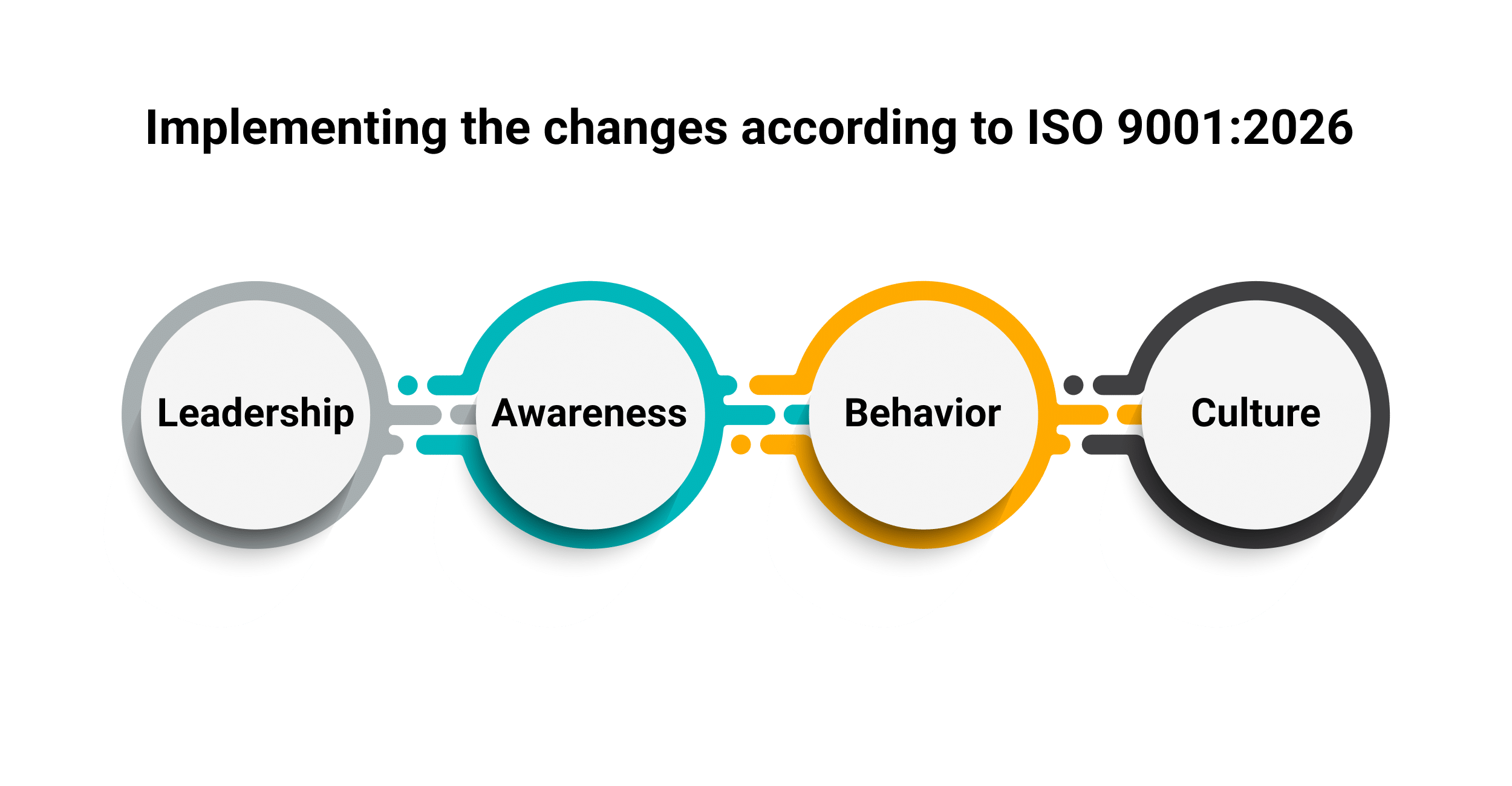
Leaders set the tone, awareness ensures that everyone understands what is expected, and awareness then guides decisions. Over time, consistent behaviors shape the culture that customers and interested parties recognize.
Top management must also promote opportunity-based thinking alongside risk-based thinking. In practice, this means creating room to evaluate beneficial changes, rather than discussing only what could go wrong.
The note to clause 7.1.4 links work environment factors with quality culture and ethical behavior. As a practical check, managers can examine whether targets, incentives, and responses to problems encourage honest reporting or pressure people to conceal concerns.
See more in: To what extent should top management be involved in your QMS?
Clause 6.1 – Risks and opportunities
A major change is that organizations are now expected to go beyond simply determining risks and opportunities; they must also analyze and evaluate them. For SMEs, this may sound like a big step, but it can be kept simple. Many companies were already doing this, especially those following Advisera’s practical guidance.
Opportunities deserve the same discipline as risks. The standard addresses them separately: Risk actions must be proportionate to their potential impact on the intended QMS results, while opportunity actions must suit the organization’s context and support desired results. This does not prescribe identical assessment methods or separate registers.
For example, a small manufacturer considering automation or a customer self-service portal should assess benefits, resources, and risks before deciding how to proceed. Planned actions must be integrated into QMS processes, and their effectiveness evaluated. Completion of a project does not, by itself, demonstrate that its intended benefits have been achieved.
Review relevant disruption risks as well. If a critical supplier fails, can the organization continue providing conforming products and services during and after the disruption? After approving a backup supplier, check whether it can meet the required specifications and delivery needs.
See more in: How to address risks and opportunities in ISO 9001.
Clause 6.3 – Planning changes
Clause 6.3 on planning changes is more demanding. The existing considerations concerning purpose, consequences, QMS integrity, resources, and responsibilities remain. Organizations must also consider communication, how they will monitor and evaluate the effectiveness of changes, and how they will review the results. The revised wording clarifies the potential impact on QMS integrity and explicitly adds information alongside resources when considering availability.
When changing the layout of a production line, for example, planning should include:
- Effectiveness: Define how success will be measured, such as reduction in cycle time, improved material flow, or fewer handling errors. Track these indicators once the new layout is in use.
- Communication: Inform operators about the reasons for the change, update work instructions, and brief logistics staff and maintenance teams. Encourage employees to provide suggestions during the transition.
- Review: At a suitable interval – for example, after three months – conduct a workshop on the shop floor to evaluate what has improved, identify where bottlenecks remain, and determine what further adjustments are still needed.
These steps align with recognized change management practices and transform clause 6.3 into a practical framework for smoother, more successful transitions.
See more in: QMS Change Management in 7 steps.
Clause 7.1.6 – Organizational knowledge
Knowledge management now goes beyond product conformity: It must support the intended results of the QMS, from compliance to customer satisfaction and improvement. Knowledge retention means capturing critical know-how so it isn’t lost when people leave or projects close — through lessons learned, knowledge repositories, or succession planning. However, knowledge only adds value when it is applied and shared. It needs to influence decisions and workflows, not just sit in documents. Practices such as updating work instructions, briefing teams, or utilizing communities of practice ensure that knowledge flows across the organization, prevents rework, and drives improvement. For example, when a production line is redesigned, lessons are captured (retained), operators use the lessons and revised methods in their work (applied), and shifts exchange and discuss the relevant know-how (shared) so the benefits spread and stick. Some knowledge is experience based and may be better retained through mentoring, supervised practice, or collaboration than through written instructions alone.
See more in: How to manage knowledge of the organization according to ISO 9001.
Clause 7.3 – Awareness
Awareness requirements also grow. People working under the organization’s control must be aware of its quality culture and ethical behavior, alongside the quality policy, relevant quality objectives, their contribution to QMS effectiveness, and the implications of nonconformity. This can be reinforced through onboarding, refresher sessions, and recognizing employees who act with integrity. Check whether people can explain what these expectations mean in their own work; training attendance alone does not demonstrate awareness.
See more in: ISO 9001 awareness training material: How to create it, what it should contain.
Clause 8.2.1 – Customer communication
Customer communication is also updated. Clause 8.2.1 requires organizations to provide relevant information about contingency actions, including those related to disruptions to the provision of products or services. Determine which customers need information, what they need to know, and when updates should be provided. For example, a small electronics company introduced a customer portal that not only provides technical documentation but also hosts announcements about planned downtime and service updates.
See more in: How the ISO 9001:2015 standard can help improve relationships with your customers.
Clauses 8.2.3.2 and 8.2.4 – New and changed requirements
Review whether order and contract records provide evidence of review results and new or changed requirements, as applicable. When requirements change, update the relevant documented information and communicate it to the relevant interested parties. For example, a revised packaging specification should reach purchasing, production, inspection, and any affected external provider before it is used. Existing orders, specifications, and digital approval records may provide the necessary evidence.
See more in: How Product Requirements work in ISO 9001.
Clauses 8.3.2 and 8.3.5 – Design planning and outputs
Where design and development apply, review whether planning considers the involvement and expected level of control of customers and other relevant interested parties. This does not require involving every interested party in every project. Design outputs must also specify the product and service information essential to their intended purpose, including safe and proper provision. For equipment, this could include installation or operating information alongside technical characteristics. Check that the relevant information reaches those responsible for subsequent provision.
See more in: ISO 9001 Design Verification vs. Design Validation.
Clause 8.4 – Control of externally provided processes, products, and services
Review the requirements communicated to external providers concerning their interactions with your organization and, where applicable, your customers and other relevant interested parties. For a delivery contractor, this could include who may confirm delivery changes, how complaints are escalated, and how staff communicate with customers. Update existing contracts or instructions where necessary; ethical or sustainability requirements should be included when relevant and applicable, not treated as universally imposed by this clause.
See more in: How to create beneficial supplier partnerships in ISO 9001.
Clause 8.5.1 – Control of production and service provision
Check that the necessary documented information is both available and used, defining characteristics, activities, and results to avoid ambiguity in operations. For SMEs, a simple one-page checklist or visual work instruction might be sufficient. The revised structure clarifies existing controls; a new form is not automatically needed.
Clause 8.5.3 – Property belonging to customers or external providers
The requirement to identify, verify, protect, and safeguard property belonging to customers or external providers remains explicit. Maintain effective existing controls and ensure that evidence of loss, damage, or unsuitability is available. The revised wording does not justify reducing protection or creating a new procedure solely for the transition.
See more in: How does ISO 9001 property clause 8.5.3 reflect on software?
Clause 9.1.2 – Customer satisfaction
Determine suitable methods for obtaining, monitoring, and reviewing customer satisfaction information. The note lists possible sources, including surveys, complaints, warranty claims, and social media; it does not require every organization to use multiple channels. Where one source gives an incomplete picture, combine it with other relevant information — for example, compare unfavorable survey scores with rising complaints or declining repeat business.
See more in: Main elements of handling customer satisfaction in ISO 9001.
Clause 9.2 – Internal audit
Each internal audit must have defined objectives, alongside its scope and criteria. Instead of repeating routine checklists, audits should target specific goals; for example, testing the effectiveness of supplier controls or checking how well employees understand ethical standards.
See more in: Five Main Steps in ISO 9001 Internal Audit.
Clause 9.3 – Management review
Management reviews must explicitly consider changes in the needs and expectations of interested parties relevant to the QMS. Review results must include decisions about continual improvement opportunities, necessary QMS changes, and resource needs.
Evaluate the effectiveness of actions addressing risks and opportunities separately, consistent with the revised inputs. Use the transition review to resolve significant gaps and resource needs rather than simply reporting the percentage of completed actions.
See more in: How to make Management Review more useful in the QMS.
Clause 10.1 – Continual improvement
Clause 10.1 brings together requirements previously addressed in clauses 10.1 and 10.3. Continually improving QMS suitability, adequacy, and effectiveness was already required in 2015. The revised clause explicitly connects improvement opportunities with monitoring, measurement, analysis, evaluation, and management review results. In practice, ask: Does our system still fit our business model?
One packaging company adopted this approach by reviewing suitability (Does the QMS support new eco-friendly products?), adequacy (Do our processes, resources, and controls adequately cover the new activities?), and effectiveness (Are we achieving our intended QMS results, including product conformity and customer satisfaction?). This resulted in the redesign of processes, updating of supplier controls, and enhancement of feedback mechanisms.
Continual improvement should not be reduced to a once-a-year agenda item. It is a discipline that ensures that the QMS evolves alongside the business.
See more in: ISO 9001 vs. Six Sigma: How they compare and how they are different.
Practical steps to implement the changes
The new revision is evolutionary, not revolutionary — but it still requires preparation. The best way to prepare is to focus on a few practical steps that address the main areas of change:
- Begin with a gap analysis against ISO 9001:2026, examining actual processes and evidence rather than only document wording.
- Review context, interested party decisions, and their consequences for the QMS.
- Assign an owner, target date, necessary resources, and intended result to each required change. An action plan can help organize this work; the standard does not prescribe a separate transition plan document.
- Update leadership practices, awareness training, and communications to reflect the emphasis on culture and ethics.
- Review how risks and opportunities are analyzed, how changes are planned, and how audits are designed.
- Review critical knowledge, customer requirement changes, contingency communications, applicable design controls, and external provider interactions.
- Adjust management reviews to explicitly consider changes in relevant interested parties’ needs and expectations and the decisions needed for improvement, QMS changes, and resources.
- Implement the necessary updates, prepare the people affected, and evaluate whether the changes work. Use internal audit and management review to assess conformity, effectiveness, and unresolved gaps before the transition audit.
Two key points stand out. First, implementation is about integration into daily work, not just updating documents. These changes only matter if they shape how people make decisions, manage risks and opportunities, and interact with customers.
Second, starting early provides time to improve, not just comply. Organizations that prepare now can use the transition to build a stronger, more resilient QMS.
Want to learn more about ISO 9001? Enroll in this free ISO 9001 Foundations Course and learn the key requirements of the standard and how they work in practice.

