 Carlos Pereira da Cruz
ISO 14001:2026 has been published, and organizations certified to ISO 14001:2015 may be asking: Do we need to implement the whole standard again?
The answer is no — this article explains how to adapt your existing Environmental Management System (EMS) to comply with this new 2026 revision of the standard.
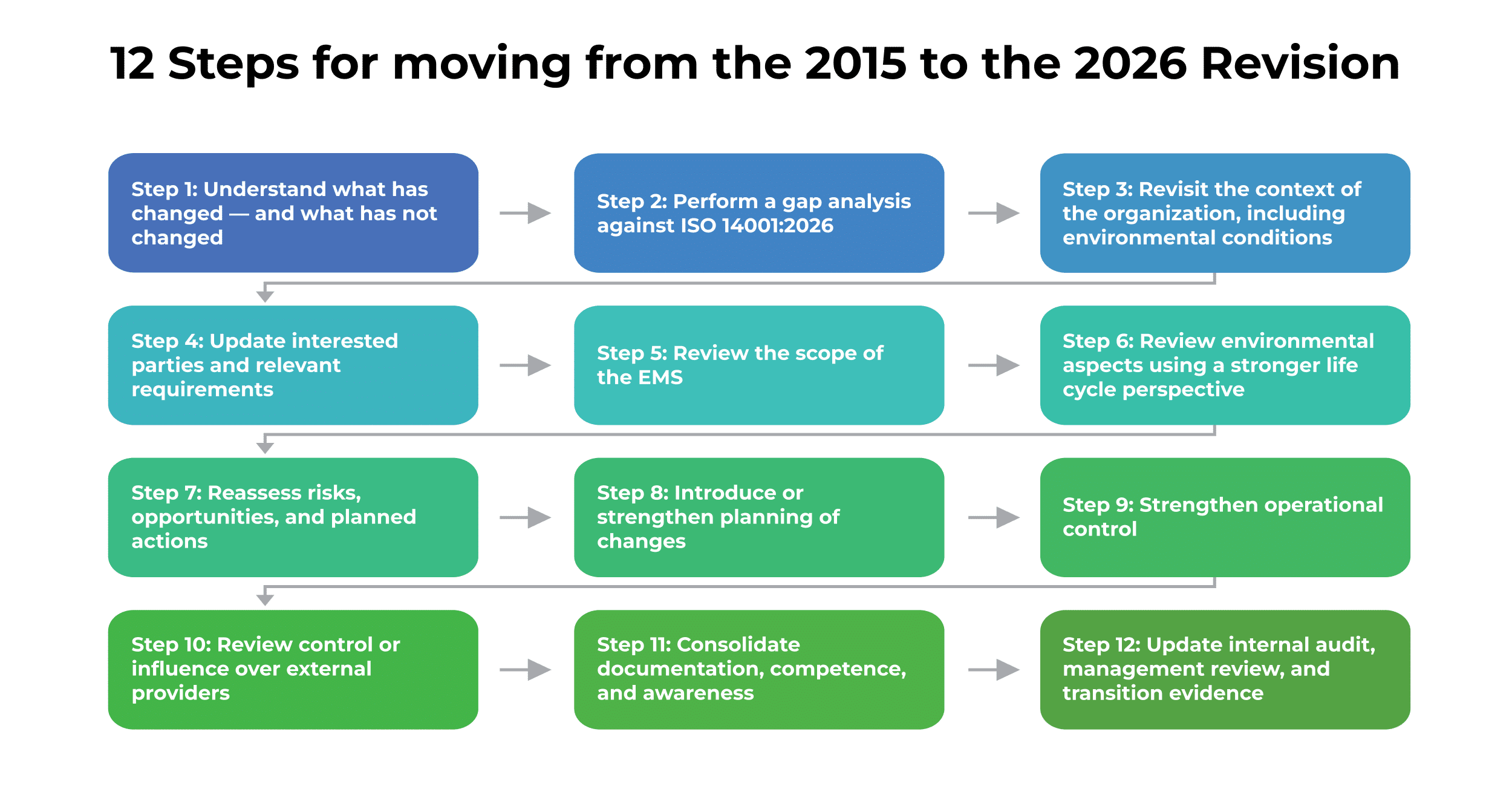
To transition from ISO 14001:2015 to ISO 14001:2026, you can use 12 steps that focus on the areas most affected by the revision: environmental conditions, interested parties, EMS scope, life cycle thinking, risks and opportunities, planning of changes, operational control, external providers, documentation, competence, internal audit, management review, and transition evidence.
ISO 14001:2026 keeps the same EMS model, structure, and Plan-Do-Check-Act logic, so most organizations with a mature ISO 14001:2015 system will not need to start from scratch.
However, the 2026 revision clarifies and strengthens expectations regarding context, environmental conditions, life cycle thinking, planning of changes, operational control, external providers, and environmental performance. Therefore, the transition should not be treated as a complete reimplementation project. It should be a structured update of your existing EMS.
Timing
Certified organizations will need to transition from ISO 14001:2015 to ISO 14001:2026 within the 36-month transition period, ending on April 15, 2029. This is the overall transition deadline; it does not mean that every organization should wait until that date to act.
The practical arrangements for each organization may depend on its certification cycle, surveillance audits, recertification timing, and the certification body’s transition process. For example, the transition may be performed as a stand-alone transition audit, combined with a surveillance audit, or combined with a recertification audit. Therefore, organizations should contact their certification body early to confirm when and how their transition audit will be conducted.
In practice, do not wait until the end of the transition period. Use the next audit cycle to update the EMS logic — I recommend using the 12 steps described below. These steps are presented in a logical sequence, but some activities will occur in parallel. In particular, documentation, competence, and awareness should be updated as the transition work progresses, not only at the end.
1) Understand what has changed — and what has not changed
Before changing documents, organizations should understand the nature of the revision. ISO 14001:2026 is evolutionary, not revolutionary. It keeps the EMS model but sharpens the expectations. In other words, the question is not “How do we build a new EMS?” The question is “How do we update our existing EMS so that it reflects the new and clarified requirements?”
This first step is important because it prevents overreaction. Some organizations may create unnecessary documents or redesign processes that already work well. Others may underestimate the revision and only change the date on procedures. Both approaches are risky.
The right approach is to understand the changes, determine their impact on your EMS, and then act where it is truly needed.
To learn more about the changes, read this article: ISO 14001:2015 vs. ISO 14001:2026 – Main differences.
2) Perform a gap analysis against ISO 14001:2026
The first practical step should be a gap analysis. This should not be limited to checking whether existing procedures mention the new clauses. A good gap analysis should verify whether the EMS addresses the new or clarified expectations in practice.
At a minimum, the gap analysis should cover context, interested parties, scope, environmental aspects, risks and opportunities, planning of changes, operational control, external providers, internal audit, management review, and relevant documents and records. The output should be a clear transition action plan: what needs to be updated, who is responsible, when it will be completed, and what evidence will demonstrate that the change has been implemented.
3) Revisit the context of the organization, including environmental conditions
Clause 4.1 deserves careful attention. Many organizations already conduct context analyses, but in some cases, these are too generic. ISO 14001:2026 clarifies that environmental conditions can be relevant to the organization’s context.
This means the organization should consider environmental conditions that can affect the EMS or be affected by the organization. Examples may include climate change, water availability, biodiversity, ecosystem health, pollution levels, resource availability, local environmental sensitivity, or regional environmental pressures.
For example, a factory located in a region facing increasing water scarcity should not treat water only as an environmental aspect. Water availability may also affect production capacity, operating costs, compliance risk, investment decisions, and business resilience.
The transition is a good opportunity to ask: Does our context analysis really reflect the environmental reality in which we operate?
You can learn more about context here: Determining the context of the organization in ISO 14001.
4) Update interested parties and relevant requirements
Most ISO 14001:2015 systems already include interested parties, but the 2026 transition is a good time to improve the quality of that analysis. The purpose is not to create a longer list of stakeholders. The purpose is to determine which needs and expectations are relevant to the EMS.
Regulators, customers, local communities, corporate groups, landlords, investors, insurers, suppliers, contractors, and waste operators may all have needs and expectations that influence the EMS. But not all of them will be equally relevant. The organization should determine which requirements need to be addressed, how they apply, and whether they influence compliance obligations, environmental objectives, operational controls, communication, or monitoring.
See also this article: Understanding the needs & expectations of interested parties in ISO 14001.
5) Review the scope of the EMS
The scope of the EMS should still be clear and practical, but the logic behind the scope should be stronger. Organizations should be able to explain where they operate, what they do, what products and services are included, what activities are covered, and where they exercise control or influence. This is especially important where outsourced activities, external providers, logistics, packaging, warehousing, or contractor activities have relevant environmental implications.
The point is not to make the scope unnecessarily broad. The point is to make it honest and transparent. A scope statement that only describes the physical site may be incomplete if important environmental issues are affected by activities outside the site’s boundaries.
You can find more detailed information in this article: How to determine the scope of the EMS according to ISO 14001:2026.
6) Review environmental aspects using a stronger life cycle perspective
The transition is a good opportunity to re-evaluate environmental aspects. Life cycle thinking was already present in ISO 14001:2015, but ISO 14001:2026 makes it harder to treat it superficially. Organizations should consider where environmental aspects occur across the life cycle of their activities, products, and services. This may include raw materials, packaging, suppliers, transport, production, maintenance, cleaning, contractors, product use, waste management, and end-of-life issues.
The organization should also consider abnormal conditions and potential emergency situations where relevant. The key question is this: Did life cycle thinking really influence the determination and evaluation of environmental aspects, or is it only mentioned in a procedure?
For more information about the life cycle perspective, read How does product life cycle influence environmental aspects according to ISO 14001:2026?
7) Reassess risks, opportunities, and planned actions
Many organizations already have risk and opportunity registers, but these are often disconnected from the rest of the EMS. ISO 14001:2026 reinforces the need for more coherent planning logic. Context, interested parties, environmental aspects, compliance obligations, risks, opportunities, objectives, and actions should not be treated as unrelated exercises.
For example, if water scarcity is a relevant external issue, water consumption is a significant environmental factor, and local authorities are imposing more restrictions, the EMS should show how these factors influence risk assessment, objectives, operational controls, monitoring, or investment decisions.
The purpose is not to create complexity. The purpose is to make planning useful.
8) Introduce or strengthen planning of changes
One of the most visible changes in ISO 14001:2026 is the explicit requirement for planning of changes. If a change can affect the EMS, it should be planned before implementation. This includes changes that may affect environmental aspects, compliance obligations, operational controls, emergency preparedness, competence, documented information, or environmental performance.
For example, suppose production wants to introduce a new solvent. In a weak system, the environmental team may be informed only after the solvent is already in use. At that point, the organization may discover that storage, emissions, waste classification, spill response, training, or compliance obligations have changed.
In a stronger system, the change is reviewed before implementation. The organization assesses environmental aspects, compliance implications, storage requirements, emissions, waste, training needs, emergency arrangements, temporary controls, and monitoring. The purpose is simple: Environmental management should not only react to change; it should help control change.
9) Strengthen operational control
Operational control is where planning becomes practice. Organizations should review whether operational controls remain adequate in light of the revised context, updated aspects, risks and opportunities, compliance obligations, and planned changes. This may include operating criteria, work instructions, maintenance controls, monitoring requirements, emergency arrangements, contractor controls, communication, competence, and response to deviations. The organization should be able to show that significant environmental aspects and relevant compliance obligations are controlled in day-to-day operations, not only described in documents.
You can find more information about the relationship between environmental aspects and operational control in this article: Understanding the relationship between environmental aspects and operational procedures.
10) Review control or influence over external providers
ISO 14001:2026 places greater emphasis on externally provided processes, products, and services. This does not mean that the organization must control everything in the supply chain. But it does mean that the organization should determine where it has control or influence and where that control or influence is relevant to the EMS’s intended outcomes.
External providers may include transport companies, waste operators, cleaning contractors, maintenance providers, outsourced warehouses, packaging suppliers, laboratories, engineering contractors, or subcontracted production processes.
Controls may include specifications, contractual requirements, supplier approval, contractor induction, operating instructions, inspections, audits, performance monitoring, incident reporting, and corrective actions.
Influence may include supplier selection criteria, communication of environmental expectations, meetings, improvement requests, preferred supplier lists, training, shared objectives, or contract renewal decisions.
The level of control or influence should be proportionate to the environmental significance and the organization’s ability to act.
11) Consolidate documentation, competence, and awareness
Documentation should not be updated only at the end of the transition. It should be updated progressively as each relevant EMS element is reviewed. This step is about consolidating those updates and ensuring that the documented EMS is aligned with the changes made in practice.
This may include context analysis, interested parties, EMS scope, aspect evaluation methodology, risks and opportunities, operational controls, supplier requirements, change management, audit programs, management review inputs, and training materials.
Organizations should also review competence and awareness. Environmental managers, process owners, purchasing, maintenance, logistics, operations, contractor managers, internal auditors, and top management may need to understand how the 2026 revision affects their responsibilities.
The goal is not just to update documents, but to ensure that people understand and apply the updated EMS in practice.
12) Update internal audit, management review, and transition evidence
Before the transition audit, the organization should confirm that the updated EMS has been implemented, audited, reviewed, and improved where needed. Update the internal audit program to cover the new or clarified requirements, and verify not only revised documents, but also whether the transition changes work in practice.
Management review should also address the transition, including gap analysis results, implementation progress, changes in context and risks, performance, compliance issues, audit results, resource needs, and decisions before certification.
Certification bodies will expect evidence that the EMS was not only updated, but also implemented, evaluated, and reviewed.
How much work will the transition require?
The amount of work will depend on the maturity of the existing EMS. Organizations with a mature ISO 14001:2015 system may find that the transition is mostly a matter of clarification, alignment, and better evidence. Organizations with a more document-based EMS may need deeper work, especially if context, aspects, risks, operational controls, external providers, and management review are disconnected.
To transition smoothly to ISO 14001:2026 without starting from scratch, use this helpful ISO 14001 Premium Documentation Toolkit that provides ready-to-use EMS documents and includes a free upgrade once the toolkit is updated for the 2026 revision.